unnamed (3)

A Critical Debate: Giftedness and the Neurodiversity Paradigm

Is classifying giftedness as a form of neurodiversity the progressive step forward we need, or does it carry too much risk?

The current push to place gifted students under the neurodiversity umbrella is sparking controversy among educators, families, and policymakers. We break down the core arguments below, with a full discussion linked to our website. and we invite you to read the two real-world opinion pieces from dedicated professionals in the gifted community.

The Central Conflict: Alignment vs. Stigma

The term neurodiversity simply means the natural variation in human brains. Proponents argue that since the gifted have «different wiring»—often described by the Asynchronous Development definition—they are clearly not neurotypical and therefore belong in the neurodiversity movement.

Arguments for Inclusion (The Pros)

Linking giftedness to neurodiversity provides authority, systemic protection, and justification for accommodations by recognizing it as a form of natural neurological difference.

  • A New Foundation for Support
  • Systemic Protection
  • Embracing Difference

Concerns About Misclassification (The Cons)

The primary risk is a fundamental misunderstanding of the term in practice which could harm gifted kids and the programs they rely on.

  • Association with Deficit
  • Erosion of Specific Support
  • Harmful Assumptions

The Front Lines: Two Voices on the Gifted-Neurodiversity Debate

unnamed1

Why the Neurodiversity Umbrella

is the Right Shield

My first thought is yes, because we (gifted people) have a diverse and unique neuro-framework that influences every aspect of our lives. Our brains work differently, and our lived and inner experiences are atypical from most others we interact with each and every day. Simple, right? 

Maybe, but what is the practical impact of this and how do others interpret the word, “neurodivergent”? Will it help gifted people thrive? Only time will tell.

Some see those who are neurodivergent as troubled or problematic. Heavily linked to autism, the term “neurodivergent” can trigger many thoughts. Whatever we label or call a different way of thinking, being, and doing, it is of paramount importance that we use neuro-affirming practices to support the gifted population and others who may fall into the neurodivergent term. Find the value, see the value and affirm the strengths. Support the challenges through a strengths-based lens for all neurodivergent people—gifted included! They should not be forced to mask who they are to ease others.

unnamed2

Why Inclusion Poses a Risk

for the Gifted

«Neurodiversity,” as it is currently intended in the public discourse, is an intellectual (i.e., non-scientific) construct originally adopted as the foundation of a human rights movement intended for autism advocacy. With time, this movement has pushed to expand the construct to include an ever-increasing number of “differences” which share the common trait of creating difficulties or “deficits.” Lately, people have started debating whether giftedness should be placed under the “neurodiversity” umbrella. I personally find this debate to be unnecessary. In contrast to all those other “differences,” giftedness, in itself, does not create difficulties or deficits; this contrast is simply too profound to be ignored. Merging it with “neurodiversities” would create the impression that giftedness too needs to be “treated.” I feel that this mindset would lead to harmful consequences for the gifted and those who care about them.
What’s YOUR Justification? 🤔 You’ve read the arguments from the gifted educator and the blogger. What do you think? PRO? CON? We want to hear the why behind your stance. Tell us in the comments of our pinned post on Facebook and Instagram: Does the systemic protection outweigh the stigma? Share your personal experience or professional reasoning!

Coming in April!

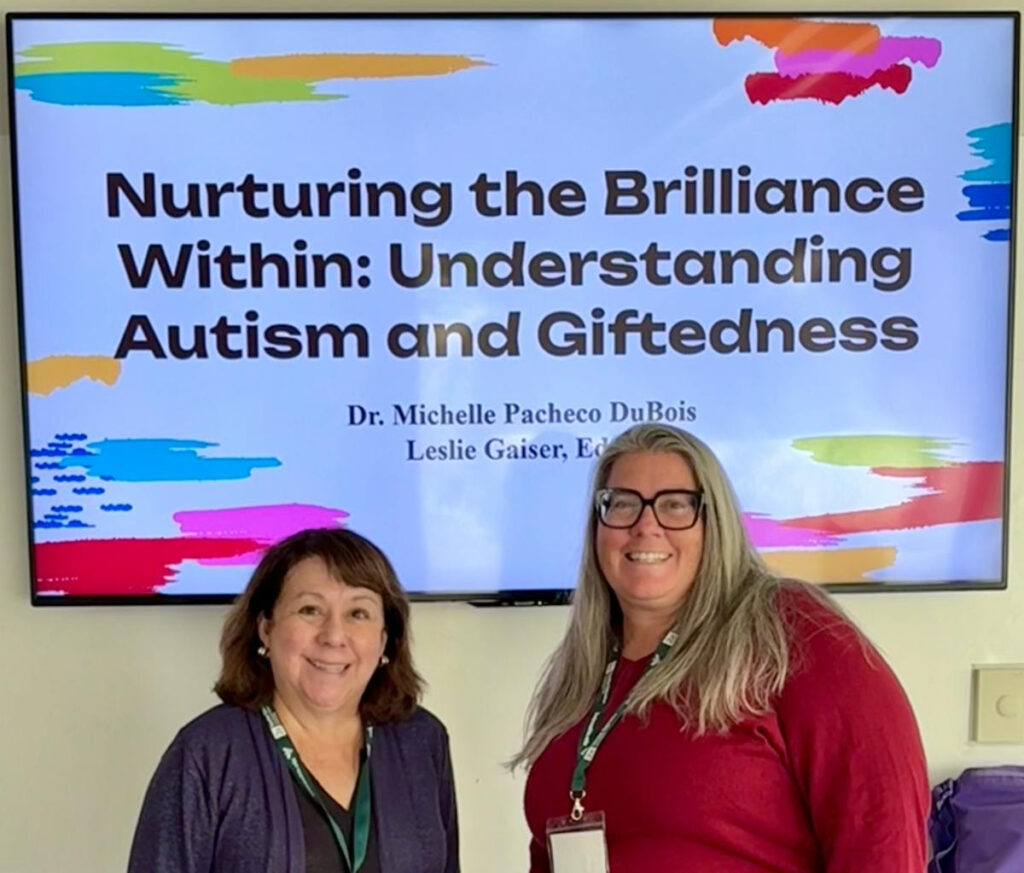
Understanding Autism and Giftedness: A Foundational Guide to Nurturing the Brilliance Within

by Michelle Pacheco DuBois and Leslie Gaiser

DuBois and Gaiser’s upcoming book, Understanding Autism and Giftedness, serves as a comprehensive resource for both educators and families seeking to identify and support gifted and talented learners with autism.

The early chapters explore the defining characteristics of both giftedness and autism, outlining effective identification practices and addressing the barriers that often hinder accurate recognition.

Later chapters focus on executive functioning skills, collaborative partnerships between schools and families, the social-emotional impacts of dual exceptionality, and policy considerations for school districts.

The book includes case scenarios with practical strategies to support gifted learners with autism. Throughout, the authors emphasize viewing these learners through the lens of neurodiversity, recognizing giftedness as an integral part of the neurodiverse paradigm. More details about the book can be found by clicking on the link below.

Understanding Autism and Giftedness: A Foundational Guide to Nurturing will be available in April from Routledge.

unnamed

Linda’s Tribute to Dr. Jim Delisle

We Will Miss You, Jim

Jim Delisle was a passionate, child-centered leader in gifted education for more than 40 years. He championed the social and emotional development of the gifted.

We met October 25, 1984, at The Roeper School. We were both on the Editorial Review Board for Roeper Review. In those days, The Roeper School held an annual meeting for the reviewers and involved them in a conference on parenting the gifted the next day. Jim adored Annemarie Roeper and called her his “adopted grandmother.” 

Jim deeply appreciated everyone in his world—especially children. His presentations were so moving that there wasn’t a dry eye in his audience. He always gave examples from the children he worked with. Although he was a university professor for most of his career, he chose to spend one day a week teaching gifted middle schoolers. In 2020, I introduced him for a virtual discussion he had with teens from Fairview High in Boulder. He wanted to know how they were coping with COVID. No one talked with teens the way Jim did. They felt deeply seen. He made a difference in the lives of thousands of gifted children all over the world. His 250 publications, including 20 books, will continue to inspire gifted children, parents, and professionals for generations to come.

unnamed (1)

Our Team is Growing

Our first line of contact with families is our office manager, and we have a new one! We are pleased to introduce Suzanne Bridges, an administrative professional and former educator with experience teaching at both the early childhood and elementary levels. She holds a Bachelor’s Degree in Communication from the University of Colorado Boulder and a Master’s Degree in Elementary Education from Regis University. Suzanne previously taught at several schools within the Adams 12 Five Star Schools District and at a private preschool in Westminster.

Suzanne is excited to join the Gifted Development Center as Office Manager and Executive Assistant, where she looks forward to continuing her professional growth and contributing to the center’s mission. She is dedicated to making a positive difference in the lives of children and their families.

Forest’s Climate News: Conservation

One of the most powerful tools we have in the fight for a livable planet is the work of making young people stewards of their places. This means giving young people the opportunity to explore natural places in their area to learn the flora, fauna, and funga. Learning about the ecosystems, watersheds and environments of our places and being able to observe changes in these systems over time is the first step in becoming conservationists. I remember when I was a young child being in the woods near our house. We would find sawdust at the base of pine trees from the ips beetles that were wreaking havoc in the forest because of prolonged drought in our area. Not only was I falling in love with the natural world, but I was developing a sense of responsibility for taking care of our land. This is what led me to caring about the much bigger topics of climate change, and inspired me to take action. For anyone interested in my reading past articles, please click the button below.
14

Two Books on Hawai‘i Reviewed by Jerry Flack

Two new exemplary picture books set in Hawai‘i are devoted to the opposite themes of loss (the extinction of songbirds) and discovery (the aloha spirit). In the Hawaiian language, the word pau means “the end.”

12

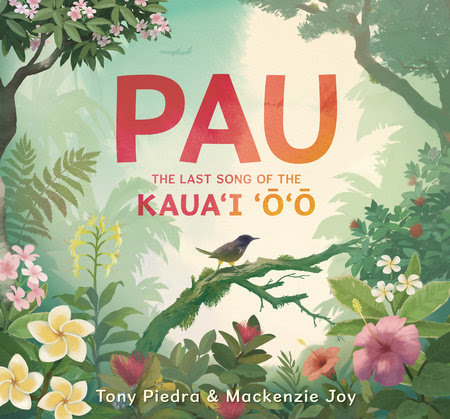
Piedra, Tony & Mackenzie Joy. PAU: The Last Song of the Kaua‘i ‘O ‘O. Somerville, MA: Candlewick Press, 2024.

In the Hawaiian language, the word pau means “the end.” In a hauntingly beautiful lament, the talented team of Tony Piedra and Mackenzie Joy use the tragic extinction of one forest songbird, the Kaua‘i ‘O ‘O, to explore the causes of the mass extinction of plant and animal life on Kaua‘i and the other islands of the Hawaiian archipelago.

13

George, Kaylin Melia. Aloha Everything. Illus. by Mae Waite. Brooklyn: Red Comet Press, 2024. Winner of the Asian/Pacific American Library Association award, 2025. Winner of the Hawai‘i Keiki Book Award, 2025.

Aloha Everything is one of the most highly honored children’s books in 2025. Poet Kaylin Melia George uses rhyming quatrains to reveal the wonders of Hawai‘i, her native state. The brilliant combination of narration and Technicolor-like illustrations in Aloha Everything is authentic.

Both books will appeal to gifted readers of all ages. In Jerry’s supplementary activities, he recommends that we ask young readers what they can do to save endangered plants and animals in Hawai‘i and all over the world. He recommends reading Forest Olson’s columns in the present and past newsletters of Gifted Development Center and Forest’s website, Climate News Monthly.


Dr. Jerry Flack is Professor Emeritus and President’s Teaching Scholar Emeritus at University of Colorado, Colorado Springs. Please see Dr. Jerry Flack’s Children’s Book Reviews of award-winning children’s books on our website. Each book has activities designed for home and school in order to to enrich the reading experience.

Entradas recomendadas